
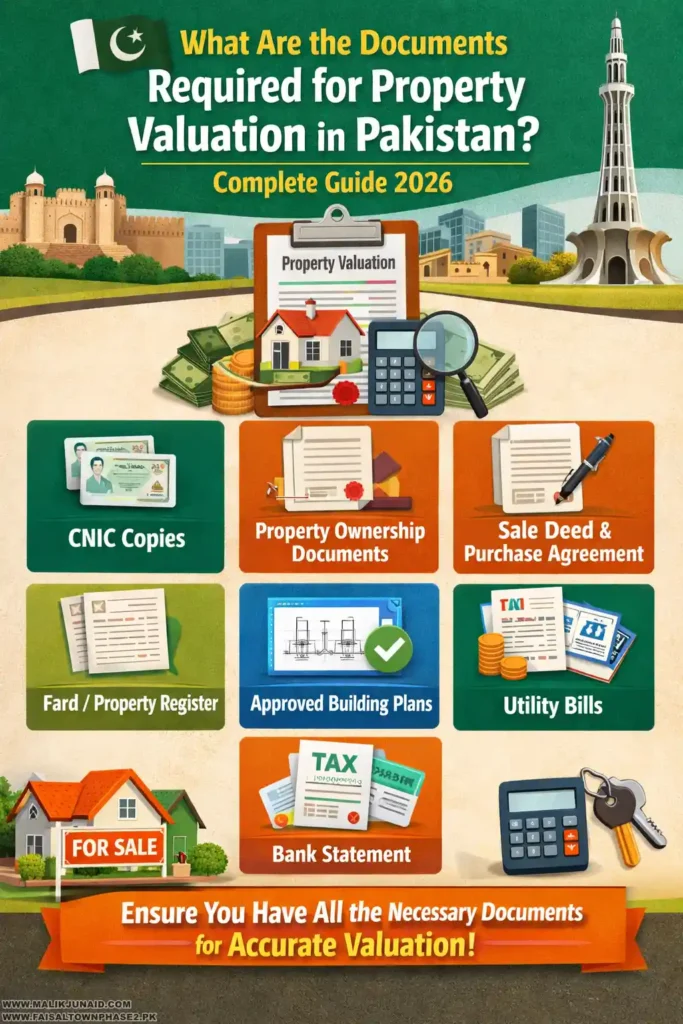
Property valuation is one of the most important steps in any real estate transaction in Pakistan. Whether you are buying, selling, transferring, gifting, mortgaging, or regularizing an immovable property, you need the right paperwork to establish the property value, verify ownership, and complete tax and stamp formalities. In Punjab especially, the process often involves dc valuation punjab, dc rate punjab, estamping punjab, and official portals such as es.punjab.gov.pk, the Punjab Zameen platform, and relevant FBR valuation tables. The Punjab e-Stamping system publicly provides DC valuation, calculates duties based on property details, and supports challan generation for stamp duty and related charges, while FBR separately issues valuation tables for immovable properties in different cities.
If you are searching for terms like dc rate list, dc value, dc valuation table, fbr property valuation, property tax in pakistan, e stamp dc valuation, or property valuation certificate pakistan, this guide will help you understand exactly which documents are commonly required and why each one matters.
For buyers, sellers, investors, and overseas Pakistanis exploring real estate opportunities, it is always wise to review a project’s legal status, location, and transfer process before moving forward. For example, if you are researching Islamabad-region options, you can review Capital Smart City, the Capital Smart City Interchange, and a broader introduction to Capital Smart City Islamabad to understand how location, access, and development progress can affect eventual property valuation.
Why property valuation matters
A proper valuation of property is not just about estimating a selling price. It is used for:
- sale and purchase transactions
- registry and transfer
- bank financing and mortgage cases
- inheritance distribution
- gift transfer and family settlement
- taxation and audit support
- court matters and dispute resolution
- calculation of property transfer fee, property purchase tax in pakistan, and related dues
In Punjab, the official dc valuation or dc value of property is frequently used as a baseline for stamp duty and registration-related calculations through the e-Stamping system. The public Punjab DC valuation calculator allows citizens to enter location and land details to calculate notified value, and the e-Stamp portal notes that DC valuation is publicly available for accurate duty calculation.
At the federal level, fbr property valuation also matters because FBR publishes notified valuation tables for various cities, which are relevant in tax-related treatment of immovable property.
What are the documents required for property valuation?
Below is the practical checklist most people need when applying for or preparing a property valuation certificate, comparing dc rates, or getting documents ready for transfer and tax calculations.
1) Copy of CNIC of the owner
The first and most basic requirement is the owner’s CNIC copy. In almost every property transaction in Pakistan, identity verification comes first. For joint ownership, copies of all co-owners are usually required. Punjab’s registry requirements include CNIC among core documents, and the e-Stamp process also relies on applicant identification information.
Why it matters:
- proves the identity of the owner
- matches ownership records
- supports valuation application and transfer documentation
2) Copy of buyer’s and seller’s CNICs
If the valuation is being prepared for sale or purchase, both parties’ CNICs are commonly needed. The Punjab e-Stamping user guide shows first party and second party information, including names, CNICs, and contact details, as part of challan information.
Why it matters:
- confirms transaction parties
- supports e stamp punjab dc valuation online and registry workflow
- reduces mismatch risk during transfer
3) Proof of ownership
This is one of the most important documents in the entire process. Proof of ownership may include:
- registered sale deed
- registry document
- allotment letter
- transfer letter
- mutation / inteqal record
- lease document
- possession letter where applicable
- previous title documents
Punjab’s property registry requirements explicitly include proof of ownership, together with CNIC and e-Stamp paper challan.
Why it matters:
- confirms the legal owner
- helps determine whether the asset is freehold, leasehold, or allotment-based
- supports the final dc property valuation and market assessment
4) Fard / mutation / inteqal record
A fresh fard, mutation entry, or inteqal extract is often needed, especially for land or older residential and agricultural property. This is particularly relevant when dealing with punjab zameen, zameen inteqal fees, rural holdings, and revenue record-based transfers.
Why it matters:
- verifies ownership in the land record system
- helps confirm khasra, khewat, and khatooni details
- is essential for land valuation punjab and agriculture land transfer fee in punjab pakistan cases
5) Property location details
A valuation cannot be completed without exact location data. This may include:
- district
- tehsil
- mouza / revenue circle
- sector / block / street
- plot number or house number
- full address
The Punjab valuation and e-Stamp systems rely on location and land type inputs to calculate dc rate, dc value, and duty.
Why it matters:
- location directly affects dc rate valuation
- needed for matching the correct dc rate list lahore, dc rate rawalpindi, dc rate faisalabad, or other city-specific rate tables
- ensures proper comparison with fbr property rates
6) Property size and measurement documents
You usually need area details such as:
- marla, kanal, square feet, square yards, or square meters
- covered area for built property
- land area for plots or agricultural land
- floor-wise covered area in multi-storey property
Punjab’s e-Stamp system uses area, location, land classification, and covered/constructed details for valuation and duty calculations.
Why it matters:
- determines dc value of property
- affects land valuation, property evaluation, and tax estimates
- required for how to calculate dc rate and dc rate calculator punjab searches
7) Site plan, map, or approved layout
For houses, commercial buildings, and files within private housing societies, a site plan or allotment map can help establish the exact location, category, and frontage. If you are assessing society-based property, having the latest map is very useful. For example, investors reviewing project-based assets often check Capital Smart City Phase 1 maps or Capital Smart City Phase 2 maps before making a valuation comparison.
Why it matters:
- helps identify corner, boulevard, park-facing, and commercial premium
- improves accuracy in property dc valuation
- supports physical inspection and comparative pricing
8) Allotment letter, transfer letter, or membership documents
For many private societies, especially in Islamabad and Rawalpindi-region projects, official society documents are essential. These may include:
- booking form
- allotment letter
- payment receipt record
- transfer letter
- membership confirmation
- possession letter
If you are dealing with a society plot, reviewing the official project pages can also help validate block and sector details, such as Capital Smart City Phase 1, Capital Smart City Phase 3, or the Capital Smart City Phase 3 payment plan.
Why it matters:
- proves allotment-based ownership
- helps valuers identify category and development status
- impacts both market value and transfer cost
9) Latest payment receipts and dues status
In private housing societies, unpaid dues can materially affect property valuation. A valuer may ask for:
- installment payment record
- development charges status
- transfer fee status
- surcharge or outstanding dues statement
This is particularly important for investors comparing value in active projects. For example, buyers often review current payment conditions, development status, and booking context in guides like Capital Smart City construction policy 2026 or Capital Smart City Phase 3 future outlook.
Why it matters:
- fully paid property may have stronger market value
- outstanding dues reduce net realizable value
- useful for transfer and financing calculations
10) e-Stamp paper challan or transaction challan
In Punjab, e-Stamping is deeply connected with property transfer and official duty calculations. The registry service checklist includes the e-Stamp paper challan as a core requirement, and the e-Stamp portal supports challan generation using property details and notified valuation.
This is why people frequently search for:
- estamping punjab
- e stamp punjab
- punjab e stamp
- government of punjab e stamp
- e stamp dc valuation punjab
- e stamp citizen portal
- www.es.punjab.gov.pk
- es punjab gov pk
Why it matters:
- links the valuation with stamp duty and registration workflow
- provides documented transaction value
- helps avoid undervaluation issues where user-provided valuation falls below DC valuation, which the Punjab portal explicitly flags.
11) Tax documents and filer information
For tax-sensitive transactions, especially sale and purchase of urban immovable property, you should also keep:
- NTN / filer status
- latest tax payment evidence where required
- transaction-related tax calculations
- previous purchase value details
- expected sale consideration
This is where fbr income tax slabs, 236k fbr, fbr gain tax on property, capital gain tax calculator pakistan, tax on property sale in pakistan, and property taxes in pakistan become relevant. FBR maintains valuation tables and related property tax frameworks for immovable property.
Why it matters:
- affects withholding tax and gain calculations
- useful for property tax calculator, fbr property tax calculator, and property transfer fee calculator estimates
- supports legal documentation in higher-value transfers
12) Utility bill or possession evidence
For built property, valuers often ask for a recent electricity, gas, or water bill, especially when verifying address, possession, or occupancy.
Why it matters:
- helps confirm the physical address
- useful in house valuation and financing cases
- supports property evaluation form pakistan documentation
13) Building approval / completion documents
If the asset is a constructed house, plaza, apartment unit, or commercial building, additional documents may include:
- approved building plan
- completion certificate
- construction cost details
- covered area statement
- photographs of the structure
Why it matters:
- construction quality and covered area influence property value
- required in bank valuation, legal settlement, and insurance cases
- helps separate land value from structure value
14) Photographs of the property
A professional valuation file often includes external and internal photographs, road access views, and surrounding area shots.
Why it matters:
- supports condition assessment
- helps identify development status
- strengthens the final property valuation certificate
15) NOC or society verification, where applicable
In private societies and new developments, project legality and status matter a lot. If you are valuing society property, it is sensible to review official NOC or project documentation. For example, buyers researching a new block may review Capital Smart City Phase 3 NOC or Capital Smart City maps and development pages.
Why it matters:
- legal clarity affects marketability
- unverified inventory may face lower market acceptance
- helpful for investment-focused valuation
Documents required for different property valuation cases
For plot valuation
You usually need:
- CNIC
- allotment or registry
- plot number and block
- map or location
- size details
- payment status
- latest dc rate list or relevant sector comparison
For house valuation
You usually need:
- CNIC
- title document
- approved map
- covered area details
- utility bill
- property photographs
- construction specifications
For agricultural land valuation
You usually need:
- CNIC
- fard / mutation / inteqal
- khasra details
- land area
- mouza and tehsil details
- land use classification
- transfer purpose details
For bank loan valuation
You usually need:
- ownership documents
- CNIC
- site plan
- market comparables
- photographs
- approved map and construction details
How DC valuation and FBR valuation differ
A lot of people confuse dc valuation with fbr valuation. They are related, but they are not always the same.
- DC valuation / dc rate is the notified value used at district level for duty and registration-related calculations, especially visible in Punjab’s e-Stamp ecosystem.
- FBR valuation is the federal notified valuation for immovable property used in tax-related frameworks and published through city-wise valuation tables.
That is why users search both dc rate lahore and fbr value of property, or compare dc rates rawalpindi with fbr property valuation before a transaction.
Common mistakes to avoid
When preparing documents for property valuation, avoid these mistakes:
- submitting an old ownership document
- using wrong area measurements
- not matching CNIC names with title records
- ignoring unpaid dues in private societies
- relying only on market rumors instead of dc rate and official valuation tables
- skipping e-Stamp verification in Punjab
- overlooking tax impact on sale or purchase
Where to get help with property valuation and investment guidance
If you want professional assistance in understanding society documentation, transfer support, and project-specific investment guidance, you can contact Gains Real Estate and Marketing Pvt Ltd through 03331003535, 03355592930, WhatsApp 03331003535, or WhatsApp 03355592930. You can also explore project information on malikjunaid.com, capitalsmartcity.com.pk, capitalsmartphase3.com, capitalsmartcityislamabad.pk, and www.faisaltownphase2.pk.
For people specifically evaluating investment-oriented inventory in Capital Smart City, these pages can be contextually useful:
- District One commercial plots in Capital Smart City
- Executive 1 Block C Capital Smart City
- Rawalpindi Ring Road impact on Capital Smart City Islamabad
- Capital Smart City Phase 3 commercial plots
- Contact page or simple contact form if you want direct project-level inquiry support
Final words
So, what are the documents required for property valuation in Pakistan?
At minimum, you should keep ready your CNIC, title documents, proof of ownership, property location, size details, supporting land record extracts, and any e-Stamp or tax-related paperwork. In Punjab, dc valuation punjab, dc rate punjab, estamp punjab, and the Punjab Zameen ecosystem play a major role in calculating official baseline values, stamp duty, and registration-related charges, while FBR valuation tables remain important for tax treatment of immovable property.
If you prepare these documents in advance, your valuation, registry, transfer, and tax calculations become much smoother, whether you are dealing with a house, plot, commercial unit, or agricultural land.